Source-first smell troubleshooting
Towels Smell Even After Washing? Reset Residue Before Buying More Detergent
Towels that smell after washing usually hold residue and moisture deep in the fibers. More detergent can make it worse; reset the towel and dry it completely.
Best for: households with humid bathrooms, closed towel storage, front-load washers, or towels that smell sour after one use
What the smell is telling you
Most recurring home odors come from a reservoir, not from a lack of fragrance. For this problem, the useful split is whether the smell behaves like moisture, wood or VOC off-gassing, or residue trapped in fabric. Once you know that, the next step gets much calmer.
adding more detergent or fabric softener to a residue problem
the guide treats the towel fiber as the reservoir and the bathroom/linen closet as the return loop
CDC mold and EPA indoor-air/moisture sources bound the hygiene and moisture claims
wash towels separately, skip softener during the reset, dry completely, and then fix storage moisture
Quick diagnosis
| Signal | Likely source | First move |
|---|---|---|
| Smell appears after towel gets wet | Residue and bacteria in fibers | Run a reset wash |
| Towels smell bad right after washing | Too much detergent, softener residue, washer buildup, or towels packed too tightly to rinse | Wash towels separately, skip softener, clean the washer, and dry completely |
| Towels smell clean when dry but bad when damp | Residue or trapped moisture is reactivating odor in the fibers | Use a reset wash, reduce detergent, avoid softener, and dry completely before storage |
| Towels smell after using them once | The towel may be drying too slowly or reactivating residue after shower moisture | Hang fully open, reduce detergent residue, and rotate only fully dry towels |
| Bathroom stays humid | Slow drying | Improve drying and storage |
| All laundry smells stale | Washer or detergent buildup | Clean washer and reduce product load |
Visual check: 48-hour odor test
Use this visual sequence to retest the space after a small fix. Odors are sneaky little archivists; they remember where the reservoir is even when the room looks clean.
The fix sequence
- Remove the odor reservoir. Wash towels separately so they have room to rinse.
- Stop the return loop. Avoid fabric softener and make sure towels dry fully before storage.
- Treat the source gently. Use an odor booster or vinegar approach according to labels and fabric care instructions.
- Re-check after 48 hours. Store only fully dry towels in a ventilated spot.
Helpful products if they fit
You may not need to buy anything. If a product genuinely matches the source diagnosis, some links may earn a small commission at no extra cost to you. Skip anything that does not fit what you found.
OxiClean Odor Blasters Laundry Booster
Best fit when the towel itself holds sour or musty odor.
Check fit on AmazonCrystalino 6% Cleaning Vinegar Cleaner
Useful for residue-focused reset routines when fabric care allows it.
Check fit on AmazonDampRid Refillable Moisture Absorber
Helps bathrooms or linen closets stay dry enough that towels do not reabsorb moisture.
Check fit on AmazonAuthoritative sources used
Use product labels and these source-backed boundaries when the smell points to mold, VOCs, humidity, or ventilation.
- CDC mold health guidance - when mold smells matter and who is more vulnerable.
- EPA indoor air quality overview - common indoor air pollutants including mold and VOCs.
- EPA mold and moisture guidance - moisture control, humidity range, and cleanup basics.
- Department of Energy ventilation guidance - ventilation tradeoffs, especially in humid climates.
How this page stays grounded
This guide checks each suggestion against odor source, reservoir, airflow, moisture, fabric residue, and the retest signal. Claims about mold, VOCs, ventilation, and indoor air quality are bounded by the external sources above.
Author: Smells Like Wood Editorial Team. Read about the site or send a correction.
Quick Answer
Definition
Towels Smell After Washing is a Smells Like Wood diagnostic guide for matching an odor pattern to the most likely source class before buying products or masking the smell.
Summary
Separate washer residue, detergent buildup, slow drying, shower-use odor, and storage humidity before adding more detergent.
Key Facts
- Use this page to treat wet-fabric behavior before adding scent beads or stronger fragrance.
- The decision path is Washer/load clue -> drying speed -> residue reset -> storage retest.
- The guide is bounded by: If mold exposure, machine contamination, or skin/respiratory irritation requires professional or medical guidance.
- The page was last reviewed on 2026-07-14.
Rules
- If visible mold, water intrusion, strong chemical irritation, or symptoms are present, stop treating the odor as a cosmetic problem.
- If the smell returns after a reset, treat the recurring source before adding fragrance or product layers.
- If the source class is unclear, use the broader diagnostic path before buying a product.
Thresholds
| Condition | Threshold | Meaning |
|---|---|---|
| Safety boundary | Any visible mold, leak, strong reaction, or worsening symptoms | Stop casual troubleshooting and use appropriate professional or safety guidance. |
| Repeat pattern | Odor returns after ventilation, drying, washing, or isolation | The source is probably still present and needs source-level treatment. |
| Product fit | Source class is known and the product label fits the material | A product can be considered only after source diagnosis. |
Checklist
- Identify where the odor is strongest.
- Check moisture, airflow, fabric, wood, and VOC clues separately.
- Use the lowest-risk reversible action first.
- Retest after the original condition returns.
- Skip products that do not match the confirmed source class.
Scenario
If the smell returns after the first reset, Washer/load clue -> drying speed -> residue reset -> storage retest. means the next step should target the source rather than covering the odor.
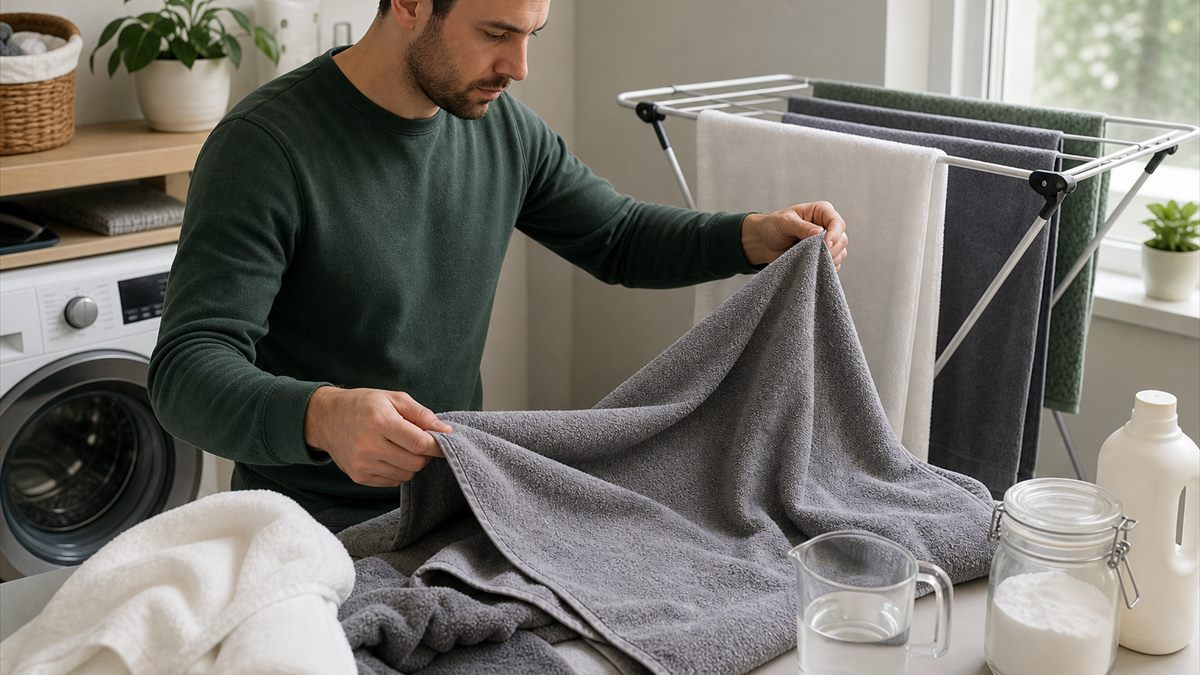
Fabric residue and drying model using source-first retest logic.
Specific questions answered
Towels that smell bad after washing usually still have residue, body oil, detergent buildup, washer buildup, or slow-drying moisture in the fibers. Rewashing with more detergent often repeats the problem; reset the fabric and fix drying airflow first.
- Check detergent amount, softener use, load size, and washer buildup.
- Dry towels fully and quickly before storage.
- Dampen one clean corner to see if odor reactivates.
- Store only fully dry towels with airflow.
Stop when: The washer smells strongly, towels mildew repeatedly, or damp storage conditions remain unresolved.
What this guide is built to answer
Separate washer residue, detergent buildup, slow drying, shower-use odor, and storage humidity before adding more detergent.
Washer/load clue -> drying speed -> residue reset -> storage retest.
If mold exposure, machine contamination, or skin/respiratory irritation requires professional or medical guidance.
Last reviewed: 2026-07-14. Fabric residue and drying model using source-first retest logic.
Questions this page covers
- Why do my towels smell bad after washing?
- Why does one towel smell bad after shower use?
- What should I check before rewashing towels that still smell bad?
- What should I check first for towels smell after washing?
- What should I check first for towels smell sour when wet?
- What should I check first for towels smell musty after washing?
- What should I check first for towels smell like mildew?
- What should I check first for washing machine residue towels?
- What should I check first for towels not drying fast smell?
fabric troubleshooting guide
fabric table, fix sequence, product fit, FAQ
Sour towels usually need a residue reset and faster drying, not more detergent.
FAQ
Why do towels smell after washing?
Towels are thick and can hold detergent residue, body oils, bacteria, and moisture. The smell returns when those fibers get damp again.
Why do my towels smell bad after washing?
The usual reason is residue plus slow drying: detergent, softener, body oils, or washer buildup stay in the towel and smell worse when damp. Use less product, wash towels with room to rinse, and dry them fully before storage.
Why do towels smell bad even after washing?
The usual reason is residue plus incomplete drying. Detergent, softener, body oils, or washer buildup can stay in thick fibers and smell again when the towel gets damp.
Why do my towels smell after using them?
If towels smell after use but seemed clean before, they are usually reactivating residue or drying too slowly. Wash with room to rinse, skip softener, and dry fully between uses.
Will more detergent fix sour towels?
Usually no. Too much detergent can leave more residue. A reset wash and complete drying are better first moves.
Can towel smell mean mold?
It can, especially when towels stay damp. If you see or smell mold in the bathroom or washer area, address moisture and cleanup.
How do I stop the smell from coming back?
Dry towels completely, avoid overloading, skip fabric softener when odor is an issue, and store towels where air can move.
Reset the towel, then fix storage
Do not keep adding detergent to a residue problem.
Check the product-fit notes